Campaign Objectives: Decide What You Want Before You Spend a Dollar
Running ads without an objective is like going to a buffet saying, "I'll eat whatever." You end up with noodles, gulab jamun, and salad on the same plate, and somehow none of it makes sense. ChatGPT Ads Manager starts with one question: What's your goal?
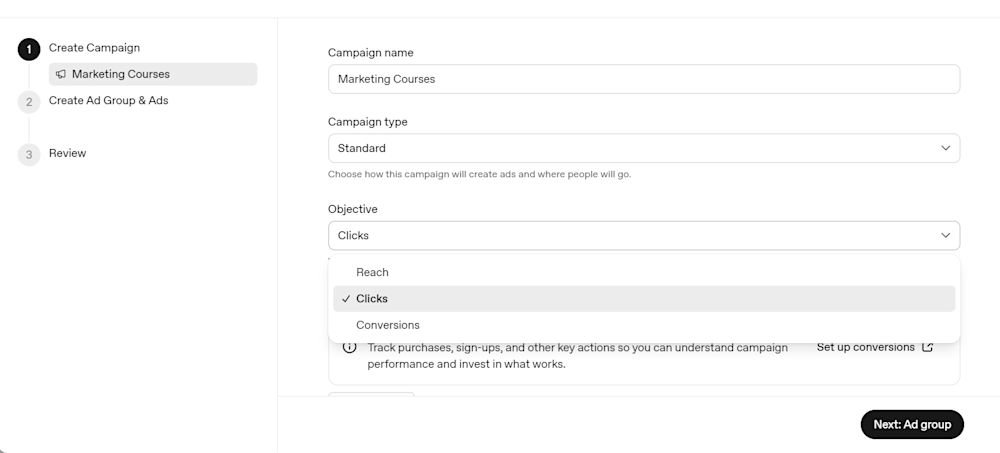
Reach: "Just let people know I exist."
This is your introduction phase. Your ad is shown to as many relevant people as possible. No pressure for them to click. Perfect for brand launches, awareness campaigns, or announcing something new.
Clicks: "Now I'm inviting you over."
Here, the goal changes. The algorithm starts finding people who are more likely to click through to your website, product page, or Instagram profile. You're no longer collecting eyeballs. You're collecting curiosity.
Conversion: "Let's make something happen."
This is the business end of the funnel. Now you want someone to purchase, sign up, book a demo, or complete another action. That requires a pixel (or conversion tracking setup) so ChatGPT knows what counts as success. As you move from Reach to Conversion, your audience naturally becomes smaller, but also warmer. Awareness casts the widest net. Conversion fishes where people are already circling the bait.
And no, Reach and Clicks campaigns don't need a pixel. Conversion campaigns do.
Location, Platform, and Audience: Choosing Your Crowd Carefully
Imagine selling snow boots in Florida. Great product. Wrong audience. Targeting is simply deciding who gets invited into the conversation.
Location Targeting
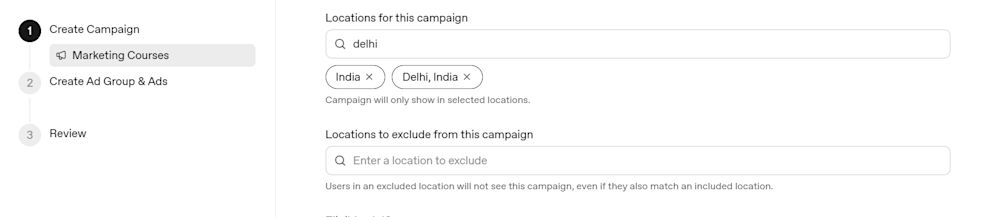
You can target ads at the country, or state level across the United States.
Location targeting helps ensure your ad appears in conversations happening in the places that matter to your business. You can focus on the states where your product or service is available, prioritize specific regions, and exclude locations where you don't operate or where different regulations apply.
It's a simple way to make your campaigns more relevant and avoid wasting impressions on the wrong audience.
Platform Targeting
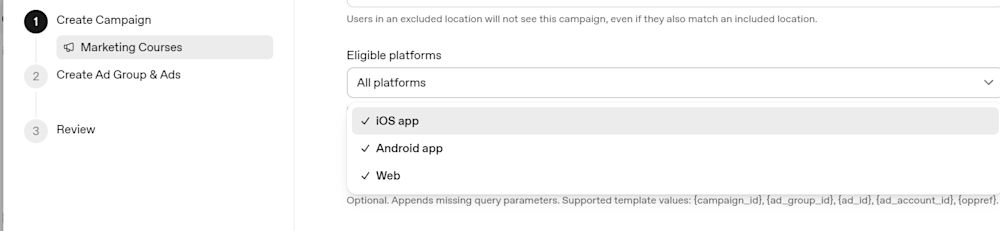
Not everyone uses ChatGPT the same way.
You can choose:
iOS app
Android app
Web (desktop and mobile browser)
If you're marketing an iPhone exclusive app in the US, showing ads only on iOS and Web makes sense. If your audience is in India, Android plus Web is usually the stronger combination because that's where a much larger share of users are.
The platform should follow the product, not the other way around.
Upload Your Own Audience

Already have customer emails or contacts?
Upload a CSV or TXT file and create a custom audience. Instead of speaking to strangers, you're reconnecting with people who already know your brand.
We will publish a whole new blog on this segment.
Budget and Bidding: Your Wallet Needs a Strategy Too
Let's talk about money, because eventually every marketing meeting becomes a spreadsheet.
Daily Budget
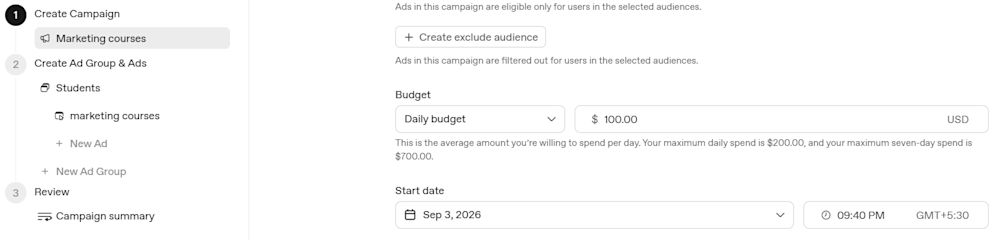
A daily budget tells ChatGPT approximately how much you want to spend each day. The current minimum starts around $25 per day.
Interesting detail: ChatGPT can spend up to twice your daily budget on days when it predicts better opportunities, but it balances that over the week so your weekly spending stays within limit.
Total Budget
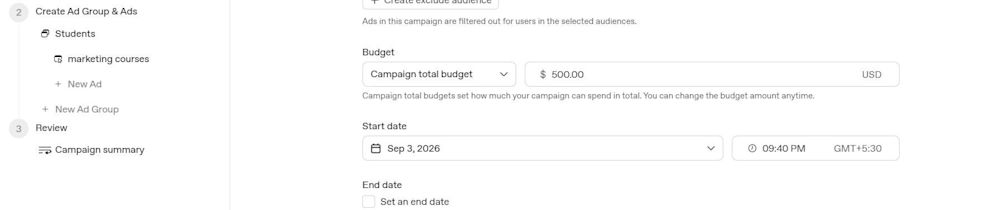
Don't want to calculate a daily budget? Just set a total campaign budget.
ChatGPT automatically spends from that amount, and once the budget is exhausted, the campaign stops on its own. No overspending, no unexpected charges, and no unpleasant surprises on your card statement.
CPM: Cost Per Thousand Impressions.
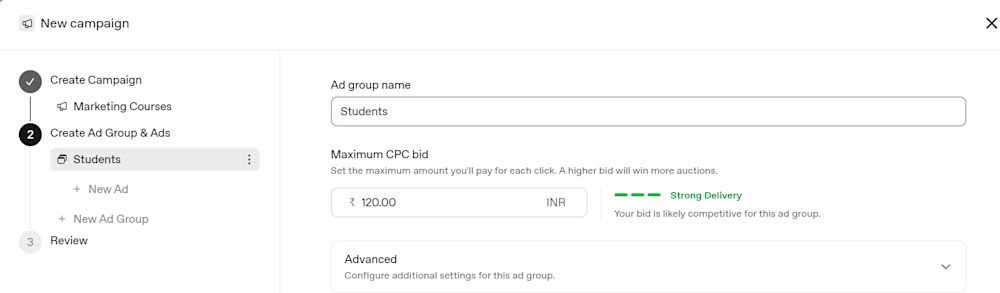
You're essentially bidding for AI visibility. If twenty coaching institutes want the same audience during admission season, CPM goes up because competition goes up.
If you're selling something niche with very few advertisers competing, you can often bid lower and still win impressions.
The interesting thing about ChatGPT ads right now? Competition is still relatively low compared to Meta or Google, which means CPMs may be more favorable while the marketplace is still growing. Early markets often reward early advertisers.
Landing page query parameters and Default Ad Destination URL
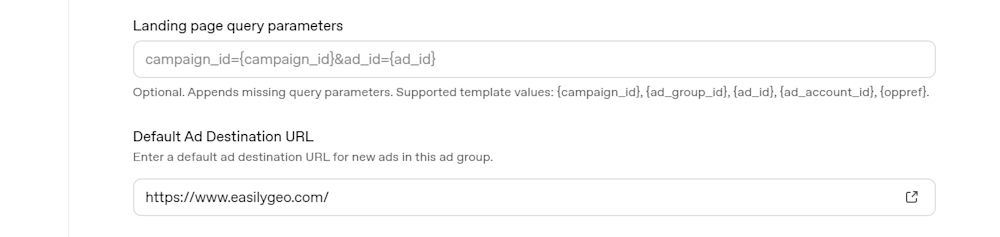
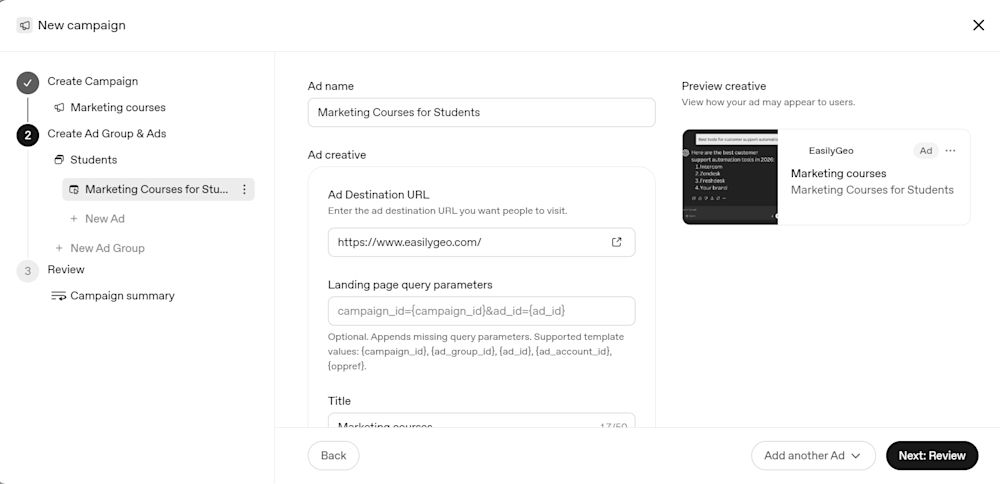
Landing page query parameters help you identify exactly which campaign, ad group, or ad generated the click without creating separate landing pages for each campaign.
For example, parameters like campaign_id, ad_group_id, or ad_id are added to your URL so analytics tools can attribute traffic, conversions, and user behavior to the correct ad. It's an easy way to measure campaign performance and keep reporting accurate.
The Default Ad Destination URL is the primary landing page where users are sent after clicking your ad. Instead of adding a destination URL to every individual ad, you can set one default URL for the entire ad group. This ensures all ads in that group lead to the correct webpage by default, while still allowing individual ads to use a different landing page if needed.
Contextual Hints: The Secret Ingredient ChatGPT Has That Others Don't
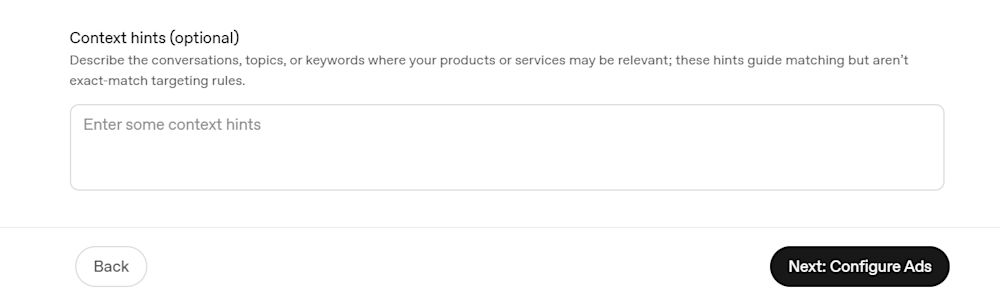
This is where ChatGPT ads stop acting like traditional ads.
Meta targets people based on who they are and what they might be interested in. Google targets searches based on what someone types into the search bar. ChatGPT targets context by understanding what the conversation is about and finding moments where an ad is genuinely relevant to the user's intent.
Instead of telling ChatGPT who should see your ad, you give it clues about where it belongs in a conversation. That could be something as simple as “remote work setup”, “best accounting software”, “planning a Japan trip”, or “I need a skincare routine for oily skin.” You can even describe complete situations in full sentences, and ChatGPT uses those contextual hints to decide when an ad is genuinely relevant to what someone is asking.
It feels less like shouting into a crowded room and more like leaving directions for the right moment. If someone is planning a trip to Japan, a travel brand fits naturally. If they're comparing accounting software, a finance tool makes sense. The conversation creates the opportunity instead of the ad interrupting it. That's the real shift: ads are moving from grabbing attention to earning it. And for brands, that changes the game because the winners won't necessarily have the loudest creatives, they'll be the ones that understand context, intent, and timing.
Ad Level: Creative
This is the final layer of the campaign structure. While the campaign defines the goal and budget, and the ad group decides who and when to show the ad, the creative determines whether someone actually clicks.
Creative Element | Purpose |
Ad Destination URL | The landing page users visit after clicking the ad. |
Image / Creative | The visual that appears alongside the sponsored response. |
Title | A short headline that communicates the offer. |
Description | One concise line explaining why the ad is relevant. |
Ready to advertise where conversations begin?
If you're wondering how to build your first ChatGPT ad campaign from choosing the right objective and contextual hints to tracking conversions, EasilyGeo can help you set it up strategically, not just launch it.
You can also do an AI visibility check on our website, to get to know if your brand clocks it or not.
Create Content for AI Visibility, make your brand discoverable in AI-powered conversations, answer engines, and contextual recommendations, so you show up when potential customers are actively looking for solutions.
Because in the AI era, visibility isn't about shouting louder. It's about showing up exactly when your audience is already looking for an answer.